Crackling, Gravy and Char Siu: A Cantonese Sunday Roast for 2026
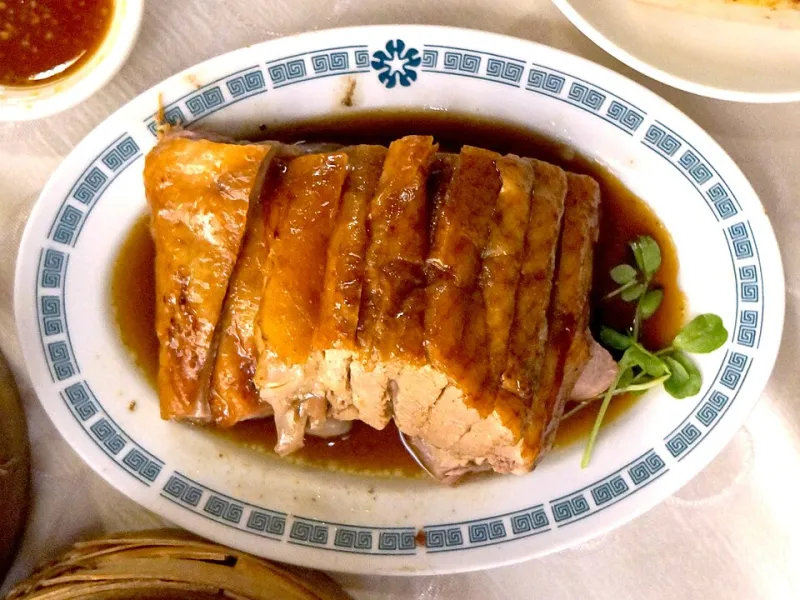
Photo: Solomon203, CC BY-SA 4.0, via Wikimedia Commons
Sunday lunch in Britain is less a meal than a small piece of theatre. There is a joint to carve, a table to stretch, gravy to pass, and a general agreement that nobody should do anything too ambitious afterwards. Yet when we talk about British-Chinese food, that Sunday slot is often missing. We are brilliant at Friday night takeaway, at Saturday dim sum, at festive menus in December. But the weekend ritual of a roast has, until recently, been left to the pub and the carvery.
That feels like an oversight. Cantonese roast meats are, in their own way, Sunday food. They are built for sharing, for carving, for the pleasure of crisp skin and soft fat, and for the sort of gravy — or sauce — that makes everyone reach for more rice. The DNA is not identical, but it is close enough to make a proper conversation.
Crackling and siu yuk are cousins
Start with the skin. A British roast pork loin with crackling and a Cantonese siu yuk with its glassy, bubbled top are chasing the same idea: contrast. One gives you dry, snapping crispness over gentle meat; the other gives you salty, brittle crackling over layers of fat and pork. The techniques differ — scoring, blanching, drying, roasting at heat — but the pleasure is the same. If you have ever fought over the crackling, you already understand siu yuk.
Then there is gravy. A British gravy is about meat juices, flour, stock and seasoning; a Cantonese master stock is about soy, sugar, ginger, star anise and time. Both are built to carry flavour into rice, potatoes, bread, whatever is on the plate. The mistake is to treat them as opposites. A roast duck gravy finished with light soy, a little Shaoxing wine and a piece of star anise can sit happily beside a Yorkshire pudding. It does not need to be a fusion stunt. It needs to taste as if it belongs.
The table can hold both
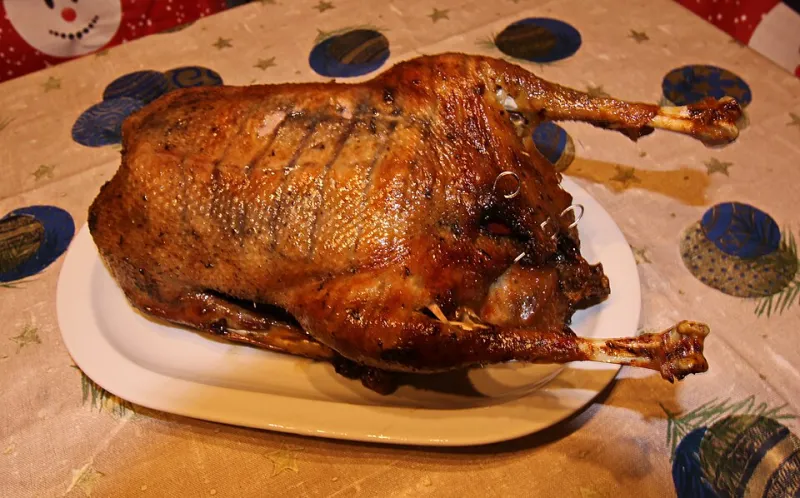
The real argument for a Cantonese Sunday roast is not that it replaces the British one. It is that the two can share a table without either losing its manners. Imagine a platter of roast duck, skin deep amber, next to a dish of roast potatoes. A tray of char siu, sticky at the edges, beside a jug of gravy. A bowl of garlicky greens and a dish of mustard greens. Yorkshire puddings are not traditional with char siu, but they are excellent for mopping up a soy-rich jus. Nobody needs to apologise for that.
The menu should be built around contrast, not clutter. Choose one centrepiece — duck is the natural choice for a gathering — and let the supporting cast do the work. Char siu brings sweetness and edge; siu yuk brings crackle; soy chicken brings gentle saltiness. Add roast potatoes, Yorkshire puddings, a green vegetable, pickles and a good mustard. If you want rice, serve rice. If you want bread sauce, leave it off. A Sunday roast is not a test of purity; it is a test of appetite.
A gravy worth arguing about
The gravy is where the two traditions can meet most usefully. Take the roasting juices from your duck or pork, skim the fat, and add a splash of light soy, a little black vinegar or Shaoxing wine, ginger and star anise. Thicken lightly. Taste for salt and sweetness. You want something savoury and deep, not a sweet sauce. If you are roasting a British-style joint, you can add the same aromatics to a conventional gravy. If you are serving Cantonese roast meats, you can keep a separate jus and let people choose. Both approaches work. The point is to give the table something generous and hot.
Mustard is another bridge. English mustard has the heat that cuts through rich pork; mustard greens, simmered with garlic and a little oyster sauce, do the same job in a different register. Pickled cucumbers or a sharp cabbage slaw will do what a spoonful of Branston often does: wake everything up.
Why Sunday suits Cantonese roast
Cantonese roast meats are made for the kind of Sunday that starts slowly and ends early. They can be cooked ahead, carved at the table and served warm rather than piping hot. They reward a big pot of tea. They do not demand a precise plating. And they suit a British appetite for gravy, potatoes and second helpings.
There is also something quietly British-Chinese about the whole idea. The best British-Chinese cooking has never been a copy of one place or another. It is a conversation between habits: the Sunday roast, the takeaway, the dim sum lunch, the tea. A Cantonese roast menu on a Sunday is not a rejection of the carvery. It is an invitation to widen the table.
A Sunday menu to try in 2026
If you are planning a Sunday gathering this winter, keep it simple. Roast duck as the centrepiece. Char siu and siu yuk on the side. Roast potatoes and Yorkshire puddings. Garlicky greens, mustard greens, pickled cucumber. A jug of soy-star anise gravy. English mustard and chilli oil. Tea, or something cold and sharp. Finish with nothing more complicated than a slice of something citrusy.
At Shangki Li, this is the sort of menu we want to see more often: modern Chinese flavours, cooked with British soul, served on the day Britain already knows how to sit down. The Sunday roast does not need to be rescued. It needs a little char siu. Book a table, bring people who like crackling, and pass the gravy both ways.