One Burner, No Roof: A Chinese Camping Supper That Beats the Weather
Photo: camping stove wok noodles outdoor cooking rainy British campsite, via www.gspretail.com
There is a moment, around six o'clock on the second day of a British camping weekend, when everyone in the field gives up and eats a burnt sausage in the rain. It does not have to be this way. A one-burner stove, a wok that has seen better days and a small bag of sauces mixed at home on Thursday can produce something genuinely good in fifteen minutes flat, in the sort of weather that makes the tent flap like a flag.
The theory is simple: Chinese cooking is fast, it is mostly about prep done in advance, and it relies on ingredients that survive a cool box far better than people assume. You are not recreating a restaurant. You are making the best supper in the field, and then listening to the people in the next pitch open another packet of crisps.
Prep on Thursday, cook on Saturday
The single biggest mistake is arriving with a bag of raw ingredients and a plan. Do the knife work at home, in a kitchen with a proper board and a sink.
- Sauce bottles. Three small jars, each enough for two people. One: light soy, oyster sauce, sugar, a splash of water. Two: black vinegar, chilli oil, a pinch of salt. Three: sesame paste or peanut butter loosened with soy and hot water for a cold noodle dressing. Label the lids with a marker.
- Aromatics. Ginger and garlic, minced and packed together in a small tub with a little oil. Spring onions, sliced, white and green separated. These are the things that make campsite food taste cooked rather than assembled.
- Meat, if you want it. Thinly sliced pork or chicken, marinated at home in soy, Shaoxing and a little cornflour, then frozen solid and used as the ice block in the cool box. It defrosts over the first day and is ready exactly when you need it.
What survives the cool box
Uncooled vegetables that shrug off a warm Saturday: carrots, cabbage, onions, spring onions, pak choi if it is bought Friday and eaten Saturday, mushrooms, and a bag of those sweet pointed peppers. Cabbage is the unsung hero of campsite cooking — it shreds in seconds, it takes a hard sear, and it does not turn to slime.
Dried things do the heavy lifting. Dried noodles, dried shiitake, a small bag of fried shallots, a tub of chilli crisp. Instant noodles are fine, but a bag of flat wheat noodles costs the same and behaves far better in a hot pan.
The kit that earns its place
You do not need much, but every item on this list is worth the weight:
- A wok, or the widest, thinnest pan you own. Thin metal responds to a camping stove better than a heavy casserole.
- A windbreak. Not optional. This is the difference between a stir-fry and a slow, sad steam.
- A heatproof mat and something to rest the hot wok on that is not the grass.
- A wooden spatula, one sharp knife, one board.
- A small bottle of groundnut or rapeseed oil with a secure lid.
- A washing-up bowl and a cloth, because a wok cleaned while it is still warm takes ninety seconds.
The method: fifteen minutes, one pot
Get the stove lit and the windbreak arranged before you do anything else. Put the noodles on to boil in the wok — they will only take four or five minutes — then lift them out into a bowl with a splash of the water and set them aside. Keep the water; it is stock by default.
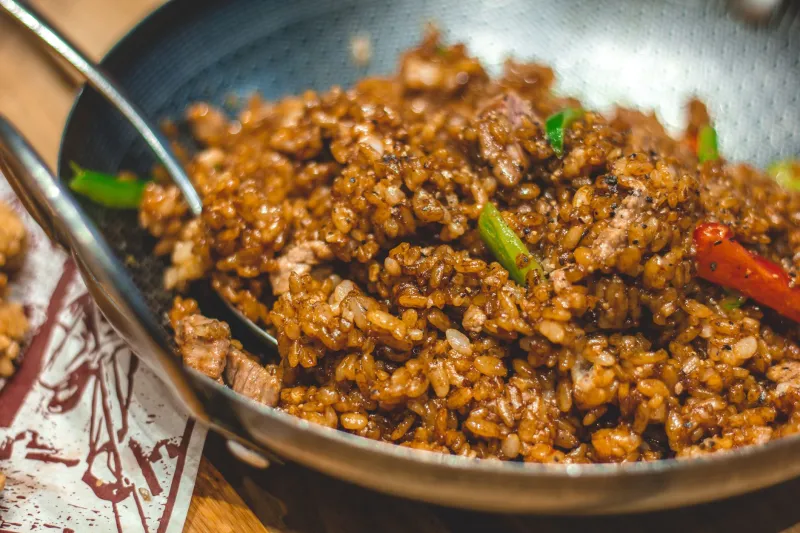
Dry the wok over the flame, add oil, and get it properly hot. In goes the ginger and garlic, then the cabbage, shredded thick, and a pinch of salt. Move it constantly. Add the marinated meat if you are using it and let it catch. Mushrooms next — soaked dried ones, squeezed out, sliced. Then the sauce jar, straight down the side of the wok so it hisses.
Tip the noodles back in, toss everything together until glossy, and loosen with a little of the noodle water if it looks tight. Off the heat: spring onion greens, a spoon of chilli crisp, fried shallots over the top.
Eat it out of the pan, sitting in a camping chair, with the stove still ticking as it cools. It will taste better than it has any right to.
If it rains, and it will
Do not fight it. String a tarp between the car and a couple of poles and cook under that, with the stove close to the tailgate so the wind is broken on two sides. A wok on a camping stove under a tarp is a proper little kitchen. Keep the gas canister out of the wet and never cook inside the tent, no matter how cold it gets — carbon monoxide is not a risk worth taking for a stir-fry.
If the weather defeats you entirely, the cold noodle version is your insurance: pre-cooked noodles tossed with the third sauce jar, shredded cabbage, carrot and spring onion, eaten lukewarm. No flame required.
Breakfast in the same pot
Wipe the wok, add water, and simmer a handful of rice or oats into a loose congee with a pinch of salt and a slice of ginger while the kettle boils. Crack an egg into it at the end and let it poach. It is restorative in a way a fried breakfast never quite manages at seven in the morning in a damp field.
Going home
Empty the water, wipe the wok, and leave it to dry over the last of the gas. The whole point of cooking like this outdoors is that it is quick, it is warm, and the only thing you have to wash up is one pan and two bowls. Pack the sauce jars with the lids tight, and next time make double — somebody in the next pitch will ask what that smell is.